
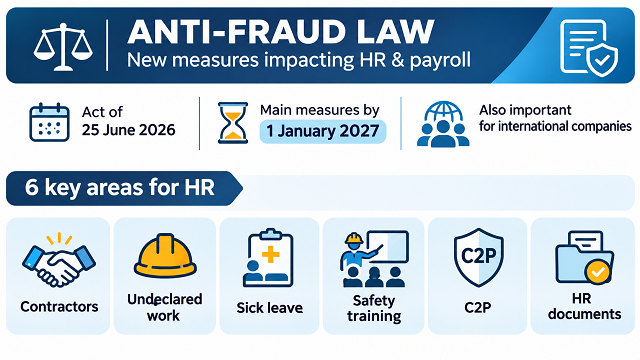
The ‘anti-fraud’ Act of 25 June 2026 includes measures affecting HR and payroll management
Act No. 2026-534 of 25 June 2026 includes measures to step up the fight against undeclared work and fraud relating to sick leave, the C2P, the CPF and training programs, etc.
Most of these measures will only come into force from a date set by decree, and no later than 1 January 2027. In the absence of further details, they will come into force on the day following the publication of the Act, i.e. from 26 June.
For international companies, some of the measures deserve particular attention because they affect contractor management, working time, sick leave, health & safety training, occupational risk exposure and HR documentation.
This overview focuses on six measures that may have practical implications for HR.
At a glance:
| Duty of vigilance – contractors | Decree due by 26 Dec 2026 | Pending |
| Undeclared work – Extended duty of vigilance | Decree due by 26 Dec 2026 | Pending |
| Sick-leave fraud | 27 June 2026 | In force |
| Prevention Passport | Phased implementation | In force |
| C2P – fraudulent declarations | 27 June 2026 | In force |
| DUERP – penalty for non-compliance | 27 June 2026 | In force |
01 | DUTY OF VIGILANCE
If you use contractors in France, compliance checks may be mandatory.
When entering into certain contracts involving work or services, the contracting company must verify that its contractor complies with French rules on undeclared work, including by checking the required supporting documents.
These checks must be performed when the contract is entered into and periodically thereafter.
The obligation to verify now extends to indirect subcontractors and is no longer limited to the direct contractor alone (French Labour Code, Art. L. 8222-1-1).
⚠️ Failure to meet these verification obligations may expose the client to joint and several liability if undeclared work is identified within the contractual chain.
The date of entry into force will be set by decree no later than 26 December 2026.
Contractor onboarding and monitoring processes should therefore take these French requirements into consideration, particularly where HR is directly involved in engaging external workers or service providers.
02 | UNDECLARED WORK
French law prohibits travail dissimulé — concealed or undeclared work.
This can include the intentional concealment of hours actually worked.
Example: deliberately failing to record or pay overtime that has actually been worked may, depending on the circumstances, constitute concealed work.
⚠️ A simple overtime dispute does not, by itself, automatically amount to travail dissimulé. The legal requirements, including intent, must be established.
Working-time recording, overtime approval and payroll processes should be consistent and auditable.
03 | SICK-LEAVE FRAUD
French employers may have a statutory obligation to supplement Social Security sickness benefits paid to employees.
The 2026 anti-fraud legislation provides that this salary-maintenance obligation does not apply where an employee has committed proven fraud to obtain Social Security daily allowances, provided that the employer has been informed of that fraud by the Social Security authorities.
The distinction matters: suspicion of fraud is not enough.
04 | Prevention Passport
The Passeport de prévention (“Prevention Passport”) is France’s digital system for recording and tracking employees’ occupational health and safety (OHS) training, qualifications and certifications.
The regulatory framework is now in place, notably under Decree No. 2025-748 of 1 August 2025, as amended by Decree No. 2026-496 of 12 June 2026.
The employer reporting functionality opened on 16 March 2026, with a transitional implementation period running until 31 December 2026. During this period, employers are required to report only certain categories of mandatory health and safety training. From 1 January 2027, the reporting obligation will extend to all eligible categories of OHS training.
Employers may consult and retain the data contained in an employee’s Prevention Passport insofar as it is necessary to monitor compliance with their occupational health and safety training obligations, unless the employee objects. No prior authorisation from the employee is required, subject to applicable data protection requirements (GDPR).
Since 27 June 2026, failure to comply with the reporting obligations may result in an administrative fine of up to €2,000 per breach, applicable to both employers and training organisations subject to the relevant reporting obligations. This maximum amount may be doubled in the event of a further breach of the same nature within two years.
The regulatory framework is therefore in force, and the system is being progressively implemented.
05 | C2P
The Compte Professionnel de Prevention (“Professional Prevention Account” a.k.a. C2P) gives employees rights when they are exposed, above the applicable thresholds, to certain occupational risk factors.
The six factors currently covered are:
Night work, Alternating shifts, Extreme temperatures, Noise, Repetitive work, Hyperbaric work.
Where the regulatory thresholds are met, employers must report the relevant exposure through the French social security reporting system (DSN).
Enhanced safeguards against fraudulent C2P declarations:
The new framework strengthens the measures available to address fraudulent conduct relating to C2P. This includes false declarations or other attempts to obtain unjustified benefits, as well as employer practices that prevent employees from acquiring the C2P rights to which they are entitled, or that reduce those rights.
06 | DUERP
Every employer in France must draft and maintain its DUERP — Document Unique d’Evaluation des Risques Professionnels (“Occupational Risks Assessment Document”), documenting the assessment of occupational risks and their prevention.
The 2026 legislation adds the absence of a DUERP to situations that may trigger an administrative fine following an inspection.
⚠️The maximum administrative fine can reach €4,000 per breach and per worker concerned, with a higher ceiling in cases of repeat breaches.
NEED TO KNOW MORE?
Not every measure will be relevant to every organisation.
The practical implications depend on the workforce, activities in France, use of contractors, working-time arrangements, occupational risks and HR processes.
HiConnect French employment-law team can help you identify which of these topics require further attention and what should be reviewed in practice.
Please feel free to reach out if you have any questions.
This communication provides general information only and does not constitute legal advice. French legislation and administrative guidance may evolve.