
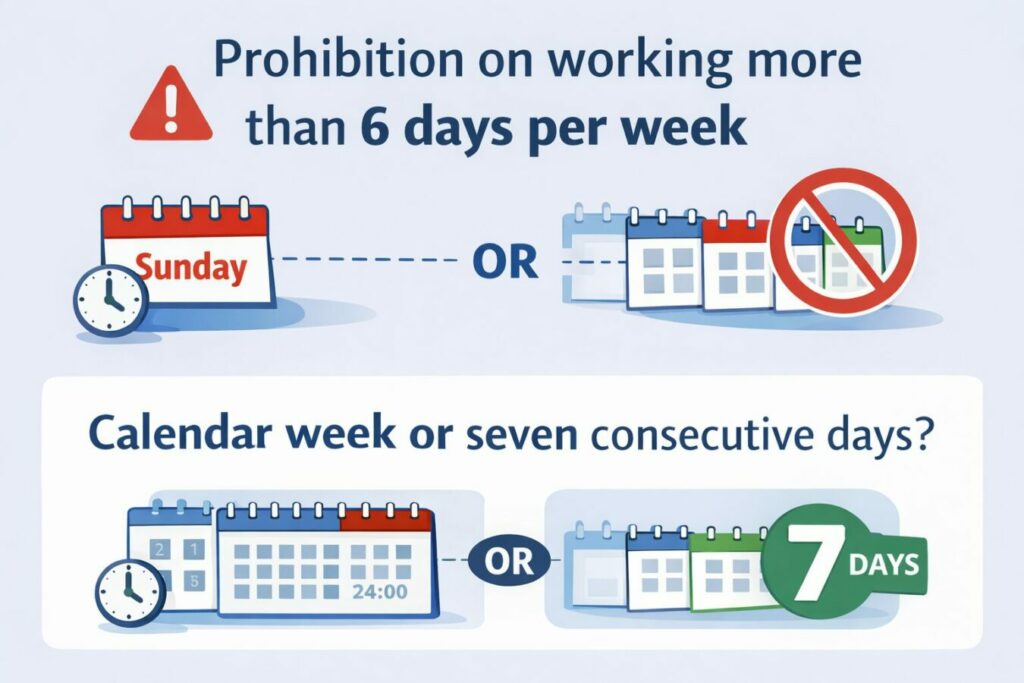
Employees whose companies benefit from an exemption from Sunday rest remain subject to the prohibition on working more than 6 days per week (Article L. 3132-1 of the French Labour Code).
The question arose as to whether this prohibition concerned the ‘calendar week beginning on Monday at 0 o’clock in the morning and ending on Sunday at midnight or any period of 7 consecutive days.
If the prohibition only applies to the ‘calendar’ week, then a system of flexible rest days could be used to give the employee his/her first weekly rest day on the Monday of the first week, for illustration purposes, and then on the Sunday of the second week, which would result in him/her working twelve consecutive days. This is authorised provided that the employee is granted once during the week a minimum of 24 hours of rest plus 11 hours of daily rest (i.e. 35 consecutive hours minimum).
Calendar week or seven consecutive days?
In a ruling dated 13 November 2025, the French High Court settled the issue and confirmed, as the administration had already indicated, that the ban on working more than six days applies to the ‘calendar week.
While it is prohibited to employ the same employee for more than six days per week, it is not prohibited to employ him/her for more than six consecutive days. In other words, it is not required that the rest day be granted no later than the day following a period of six consecutive working days, but it is required that this rest be granted within the seven-day calendar week period. The Court bases its ruling on the lack of precision regarding the timing of weekly rest periods in Article L. 3132-1 of the Labour Code and in European law.
It therefore rejected the claim for compensation from an employee who had worked a period of 11 consecutive days and then a period of 12 consecutive days.
However, it remains good practice to grant weekly rest as soon as possible before or after Sunday work.
In addition, a collective bargaining agreement for the sector of activity to which the company belongs, or signed in the company could also impose other rules in this regard. It is therefore essential to examine each case considering the specific regulations applicable to the company and its employees.
Should you require any assistance for fulfilling your obligation, please do not hesitate to contact us.