
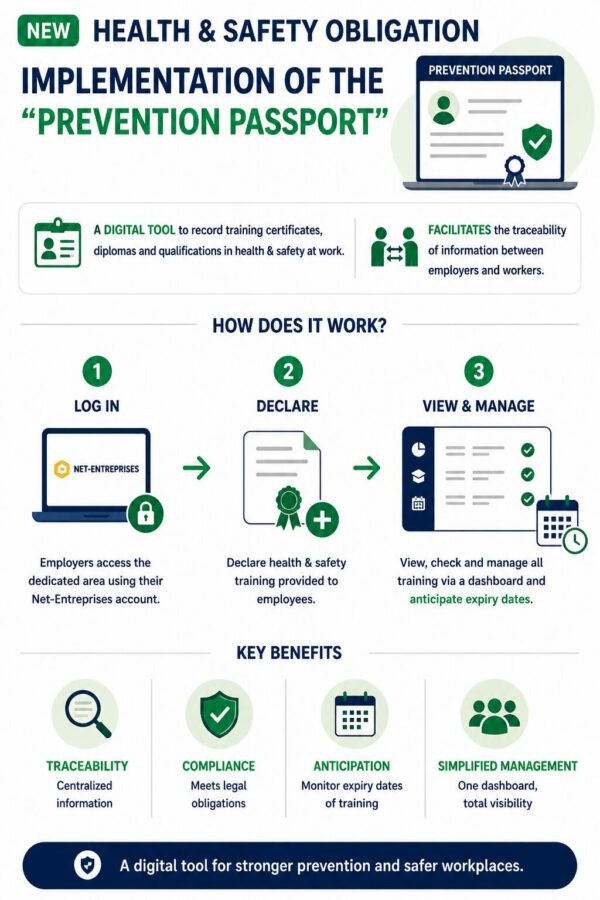
- What is it?
The prevention passport is a digital tool used to record the training certificates, diplomas and qualifications obtained by an employee or job seeker as part of training courses relating to health and safety at work (Labor Code, Art. L. 4141-5).
It aims at facilitating the traceability of information between employers and workers (employees, trainees, etc.) regarding the training courses they have taken.
Once logged into the dedicated area using their Net-Entreprises account, employers can declare the occupational health and safety training courses provided to their employees.
They can also view and check the declarations made by training organizations on their behalf, but above all, they can manage all training courses via a dashboard and anticipate their expiry dates in order to keep their employees’ skills levels up to date.
- Training courses to be declared
The occupational health and safety training courses listed in the training passport can be divided into four categories:
-
- compulsory training courses, which are fully regulated (e.g. training courses on preventing exposure to asbestos);
- compulsory training for jobs requiring authorization or certification from the employer (e.g. training on working with electrical installations or pyrotechnic risks);
- compulsory training with a specific objective set out in regulations (e.g. training on handling loads or preventing chemical risks);
- training not required by regulations but meeting the employer’s general training obligation (e.g. training on psychosocial risks).
Of these four categories of training, only training courses that meet all three of the following conditions must be declared on the prevention passport:
-
- meet an occupational risk prevention objective or the general obligation to train workers;
- result in the issuance of a training certificate or proof of successful completion;
- enable the mobilization of knowledge and skills acquired or developed during the training and transferable to any other workplace exposing workers to occupational risks similar to those present in the workplace occupied by the worker on the date of the training.
A simulator of eligible training courses is available on the passport information portal:
https://passeport-prevention.travail-emploi.gouv.fr/espace-public/realiser-une-simulation
- Training courses not to be declared
However, the following are not included in the prevention passport:
-
- training courses for trainers enabling them to provide training on occupational risk prevention;
- safety training relating to working conditions;
- training courses designed to ensure the safety of persons and property, with the exception of first aid training in the workplace and additional training courses relating to the protection of persons or property that aim at interventions in specific occupational risk contexts (e.g. training courses enabling rescue operations to be carried out in hyperbaric or nuclear environments);
- training in health, safety and working conditions for members of the Social and Economic Committee (CSE);
- training for prevention officers, with the exception of specific additional training such as those provided to employees competent to deal with occupational risk protection and prevention activities within the company, persons competent in radiation protection or hyperbaric prevention advisers.
- Scope of the employer’s obligation
As soon as their dedicated space opens, scheduled for March 16th, 2026, employers will be required to declare eligible occupational health and safety training courses provided to their employees and to verify the declarations made by training organizations on their behalf.
In the case of temporary workers, this obligation applies to the temporary employment agencies.
Training courses completed before the effective implementation of the system are not subject to this reporting obligation.
Only training courses delivered to employees from the opening of the service onwards will have to be recorded in the prevention passport.
However, to facilitate monitoring, it will eventually be possible for them to integrate previous training courses.
- Transitional period
In order to facilitate the implementation of the tool, the declarations will be introduced gradually.
A transitional period is planned:
-
- until September 30th, 2026, only compulsory training courses covered by regulations and those required to occupy positions requiring authorization or accreditation from the employer will have to be declared.
- from October 1st, 2026, all eligible training courses must be reported.
To support this ramp-up and facilitate reporting, the Caisse des Dépôts (the institution managing the tool) will roll out a feature on July 9th, 2026, enabling employers and training organizations to report training courses provided in bulk by submitting files.
- Timeline for declaring and verifying
For internal training courses (provided without going through a training provider), the employer must submit declarations within six months from the end of the quarter:
-
- during which the training course ended, for training courses that only result in the issuance of a training certificate; Example: for a training that resulted in the issuance of a training certificate on April 2nd, 2026 (i.e. in the second quarter of 2026), the employer must declare the training within six months of the end of the quarter (i.e. 30 June 2026), or before 31 December 2026.
- marking the start of the validity period of the certificate of completion issued to the holder.
For training courses taken at the employer’s initiative with a training organization, the training organization may directly enter the information in the passport, but the employer remains solely responsible of its content and accuracy.
Note: in principle, when the training organization enters information into the passport on behalf of the employer, the employer will receive a notification.
The employer must then verify the accuracy of the organization’s declaration. They can do so up to six months after the end of the quarter during which the training ended or during which the certificate of completion became valid.
During this period, they may ask the organization to correct or complete their declaration.
If they do not verify the declaration, it is deemed to have been verified. Until July 9th, 2026, the deadlines for declaration and verification are extended by three months (i.e. a maximum of 12 months).
If the training organization fails to submit a declaration within the three-month timeline, the employer must provide information on the training within nine months of the expiry of this deadline.
This provision will come into force as soon as the bulk data import functionality is available, i.e. on July 9th, 2026.
- Penalty
In the event of failure to comply with the obligation to declare training courses on the training passport and to verify their accuracy, the employer is liable to a fine of €10,000 per employee concerned.
In the event of a repeated(?) offence, the penalties incurred are one year’s imprisonment and a fine of €30,000.
Furthermore, failure to declare training on the training passport may suggest that the employer has failed in their safety obligation. Should this be the case, this failure could give rise to damages in the event of claim.
This article, as well as many more, is also available on our LinkedIn page :
Feel free to follow us to stay updated with our latest insights:
👉 https://www.linkedin.com/company/2123789/admin/page-posts/published/
Should you have any questions, please do not hesitate to contact us.